Kogui Village of Gungulaja
Kogui Village of Gungulaja
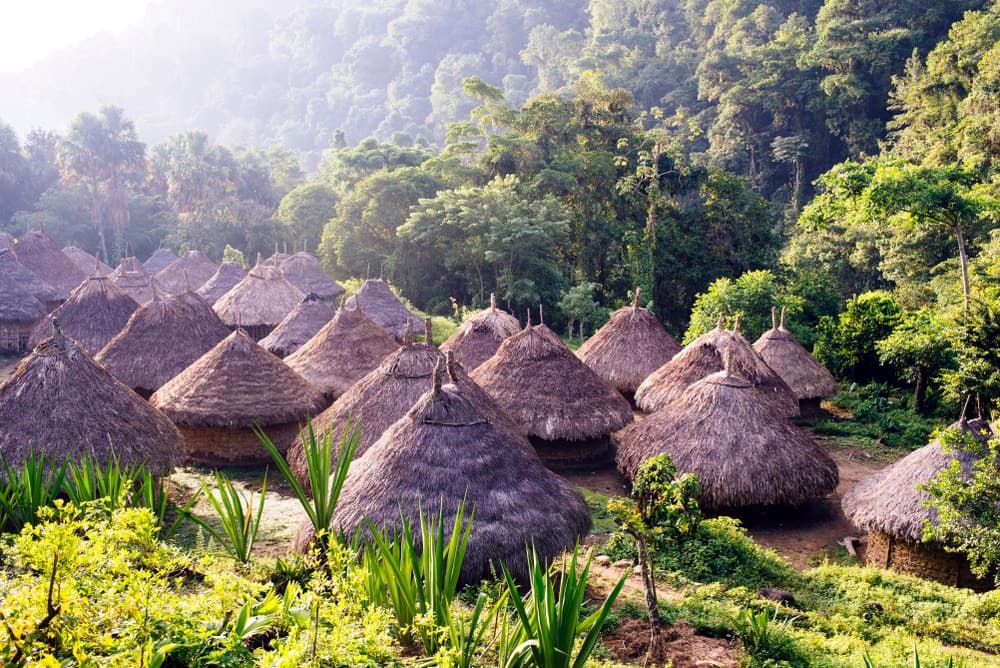
Perched on the slopes of the Sierra Nevada of Santa Marta, the village of Gungulaja is home to the Koguis, descendants of the Tayronas. Visits are guided by the Mamo.
The village of Gungulaja, perched on the slopes of the Sierra Nevada of Santa Marta, is home to a Kogui (or Kággabba) community, direct descendant of the Tayrona civilization. Visiting this community is not something to improvise: access requires authorization from the Mamo, the spiritual leader, and must necessarily go through an accredited local guide. A structured encounter that allows you to approach one of the last pre-Columbian peoples of South America to have preserved its language, cosmogony and social organization.
Why visit the village of Gungulaja
The Koguis are the living heirs of Tayrona culture, which shaped the Sierra Nevada long before the arrival of the Spanish. Their presence in this isolated coastal mountain range, which rises above 5,700 m facing the Caribbean Sea, enabled them to maintain a worldview structured around the balance between celestial, terrestrial and human forces.
A visit to Gungulaja provides rare insight into:
- the spiritual organization of a society guided by the Mamos;
- traditional textile craftsmanship, particularly the mochila, woven from natural fibers;
- the dress codes and rituals that punctuate community life;
- an ancestral ecological approach to the territory, considered as a living being to protect.
Contact remains measured: this is not a folkloric attraction but a respectful exchange with a community that decides for itself what it shares.
History and Tayrona heritage
The Koguis (or Kággabba) are the last descendants of the Tayrona civilization, whose most famous remains are now gathered at Ciudad Perdida. During the Spanish conquest in the 16th century, part of the Tayronas retreated into the highlands of the Sierra Nevada to escape colonization. It was in these high-altitude valleys, difficult to access, that their descendants maintained cultural continuity for over five centuries.
The village of Gungulaja is part of this network of communities spread across the slopes of the Sierra. Each village has its own Mamo, its kankurua (ceremonial house) and its sacred territory.
What you will discover there
The role of the Mamo
The Mamo is the spiritual leader: priest, scholar and shaman, mediator between the celestial powers and mankind. He is the guardian of the balance of forces, keeper of sacred objects and healer. It is he who conducts the rituals and who authorizes (or not) the presence of an outside visitor in the village. His word structures collective life.
The mochila, weaving of daily life
The mochila (Spanish spelling, sometimes written mochilla), also called tutu in the Kogui language, is woven by women in 100% natural fibers. It accompanies every member of the community.
- A man carries 2 or 3 mochilas simultaneously: one for personal belongings, one for the poporo, a sacred object containing a small bag of coca leaves.
- Women use the mochila worn around the head to carry their baby.
- Girls present their first completed mochila to the Mamo, who blesses it. This act marks their entry into textile transmission.
Traditional dress
Kogui clothing is entirely made by the community, in white cotton:
- women wear a white tunic with one shoulder bare and colorful necklaces;
- men wear white trousers called Kalasuna and a long shirt (mulla) named Yakna.
Both men and women keep their mochila slung over their shoulder at all times.
Music and dance
Music is a medium for oral transmission: stories, visions and knowledge are inscribed within it. Men hold the instruments, women lead the dance by tying a rattle to their ankles, the kumuna or kuckui, which marks the rhythm.
Practical information
- Prior authorization: access to the village requires the Mamo's approval. No visit can be organized independently.
- Guide required: go through a local operator known to the community, who acts as an intermediary and translator.
- Etiquette: ask before taking photographs (often refused), do not enter the kankurua without an invitation, respect sacred areas.
- Clothing: sober clothing, hiking shoes, sun protection and light waterproof jacket.
- Duration: the visit can range from a half-day to several days depending on the authorization granted.
When to go
The dry season, from December to March, remains the most favorable: passable trails, more stable temperatures at altitude, lower risk of tropical storms. The rainy season (April-November) makes access difficult and may result in postponements.
How to get there
The logical starting point is Santa Marta, in the department of Magdalena, in northern Colombie. The city is served by the international Simón-Bolívar airport, with direct connections from Bogotá and Medellín.
From Santa Marta:
- transfer by 4x4 to the foothills of the Sierra Nevada;
- final portion on foot, accompanied by the guide who has obtained authorization from the Mamo;
- the total duration of approach varies depending on the village and the condition of the tracks.
Nearby
The Santa Marta region has several sites that complement a visit to the Koguis:
- Tayrona National Park, on the Caribbean coast, which shares the cultural heritage of the Koguis' ancestors;
- Ciudad Perdida (Teyuna), a Tayrona city accessible by a 4 to 5 day trek in the Sierra Nevada;
- coastal villages and beaches at Palomino further east.
To further explore the pre-Columbian cultures of the country, the Gold Museum in Bogotá and the archaeological park at Villa de Leyva offer valuable historical context.
Frequently asked questions
Frequently asked questions
Plan your trip
The encounter with the Koguis fits naturally into a broader itinerary around Santa Marta, the Sierra Nevada and the Caribbean coast. To build a coherent trip that respects the communities visited, consult our travels in Colombie.
Interested in this visit?
We can include it in your personalised itinerary.