The Santo Eccehomo Monastery
The Santo Eccehomo Monastery
A Dominican convent founded in 1620 twelve kilometers from Villa de Leyva, the Santo Eccehomo Monastery preserves a Mudejar cloister and stone slabs embedded with marine fossils.
The Santo Eccehomo Monastery is a Dominican convent located twelve kilometers from Villa de Leyva, in the countryside of Boyacá. Listed as an architectural heritage site of Colombia, it bears witness to the presence of the Dominican order in the region since the 17th century and preserves a rare and well-preserved Mudejar architectural ensemble from New Granada.
Why visit the Santo Eccehomo Monastery
The monastery appeals to three types of travelers: those drawn to Colombian colonial history, enthusiasts of religious architecture, and visitors seeking a tranquil site away from well-trodden tourist routes. The visit pairs easily with a half-day in Villa de Leyva.
- An early 17th-century ensemble that has remained largely authentic.
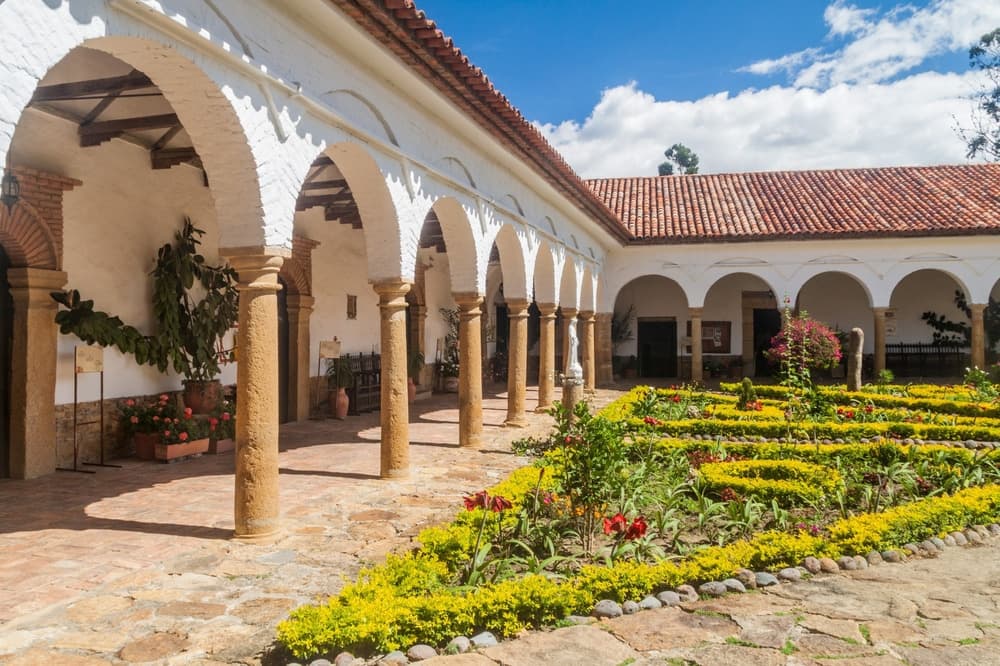
- A cloister with four galleries surrounding a courtyard with a well.
- Floor slabs containing marine fossils, evidence of the region's geology.
- A small museum of religious relics and liturgical objects.
History of the monastery
The Santo Eccehomo Monastery was founded on March 15, 1620 by Juan de Mayorga Casallas. According to local tradition, it was built in honor of his sister Catalina, to whom Saint Bartholomew reportedly appeared, asking for the construction of a convent. In its early years, the site served three purposes: an evangelization center, a rest house, and a medical facility for the elderly.
The convent's history was marked by several disruptions. In 1816, amid the wars of independence, the Dominicans were expelled by troops under General Manuel Roergas Serviez. The building subsequently passed through several hands before the Dominicans reclaimed it in 1868. Since then, priests have resided there once again, and various restoration campaigns have helped preserve the church and convent buildings.
What to see on-site
The symbolic organization of the site
The monastery follows a symbolic layout: the cemetery is located to the north (heaven), the church occupies the center (God), and the monastery proper extends to the west. This arrangement can still be clearly observed today in the flow between buildings.
The church and its façade
The façade blends brick and stone in the 17th-century Spanish style, with a tile roof and a large wooden door. Inside, the decoration reflects Mudejar art of New Granada, an inheritance of the Hispano-Moorish influences brought by the colonists. The gilded altarpiece and statues of Christ form the visual center of the sanctuary.
The cloister and inner courtyard
A small wooden door to the right of the church opens onto the cloister. Four galleries surround an inner courtyard organized around a well, an element that is both functional and symbolically significant to monastic life. The stone slabs paving portions of the floor contain marine fossils, remnants of the ancient inland sea that once covered the Cundiboyacense plateau.
The museum and annexes
Several rooms, arranged in former cells, display religious relics and liturgical objects. Other spaces serve as living quarters for the clergy, a conference room, or a small café. In the left wing, a stone doorway leads to the cemetery where Dominican friars who served in the community are buried.
Practical information
- Duration of visit: allow 1 to 1.5 hours on-site, longer if you include lunch or a stroll through the surroundings.
- Opening days: Tuesday to Sunday; closed Mondays. Hours generally span the day; check locally before visiting.
- Admission: modest entrance fee, payable in cash on-site.
- Dress code: respectful attire required, as the site remains an active place of worship.
- What to bring: water, hat, and sturdy shoes—the access and surroundings offer little shade.
How to get there
The monastery is located approximately twelve kilometers east of Villa de Leyva, in the municipality of Sutamarchán. Three options:
- Taxi from Villa de Leyva: the simplest solution. Arrange with your driver for a round trip with waiting time on-site.
- Rental car: the road is paved then becomes a passable dirt road. Parking is easy.
- Organized tour: some excursions combine the monastery with other sites in the valley (paleontological museum, El Fósil fossil site, vineyards).
What to see in the surrounding area
The region concentrates several complementary sites, all accessible from the same base:
- Villa de Leyva and its cobblestone Plaza Mayor, the logical starting point.
- Pozos Azules, a series of pools with turquoise waters in a semi-arid landscape.
- The paleontological site of El Fósil and the remains of Monquirá (Infiernito).
- To compare with other well-preserved colonial villages in the country, see Guane.
Frequently asked questions
Frequently asked questions
Yes, the church, cloister, and museum can be explored at your own pace during opening hours. However, the convent remains an inhabited place of worship, and certain areas are reserved for the clergy.
One to one and a half hours are sufficient to tour the church, cloister, and museum. Allow a half-day if you combine it with another site in the valley.
Yes, a taxi remains the most practical option. Ask your driver to wait for you on-site, as spontaneous rides are rare.
The site is generally closed on Mondays. Hours may change depending on religious services or local holidays.
Yes. Some of the stone slabs used for paving contain marine fossils, which are common in the Villa de Leyva region, an ancient Cretaceous seabed.
Incorporating the Santo Eccehomo Monastery into your trip
The monastery fits naturally into an itinerary through Boyacá, as a complement to Villa de Leyva and the paleontological sites of the valley. To build a custom route including this stop, consult our suggestions for travel in Colombia.
Interested in this visit?
We can include it in your personalised itinerary.